
Starting April 27, 2026 the NSF now requires researchers to submit a data management and sharing plan on Research.gov. Please see updated guidance below.
National Science Foundation Requirement
Since 2011, the National Science Foundation (NSF) has required Data Management and Sharing Plans (DMS Plans) for incoming grant applications. Read the full policy and requirements: Preparing Your Data Management and Sharing Plan.
Effective April 27, 2026, the Data Management & Sharing Plan (DMS Plan) must be created using the Research.gov DMS Plan form.
What Is Required?
Investigators are expected to share with other researchers, at no more than incremental cost, and within a reasonable time, the primary data, samples, physical collections, and other supporting materials created or gathered in the course of work under NSF grants.
- Proposals must include a DMS Plan created using the tool implemented on Research.gov. This document should describe how the proposal will conform to NSF policy on the dissemination and sharing of research results.
- Scientific datasets underlying peer-reviewed scholarly publications resulting from federally funded research should be made publicly available as per the DMS Plan.
What Do I Need To Submit?
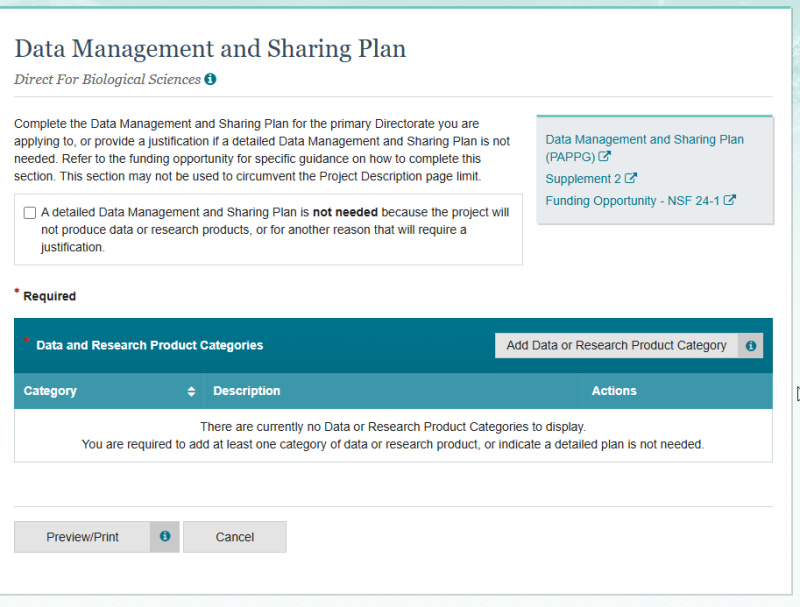
For each project proposal include a DMS Plan for the primary Directorate you are applying to, or provide a justification if a detailed DMS Plan is not needed. Refer to the funding opportunity for specific guidance on how to complete this section. You can preview the Research.gov DMS Plan form.
Write an NSF DMS Plan
Complete the Data Management and Sharing Plan for the primary Directorate you are applying to. The directorate and/or division guidance on Preparing Your Data Management and Sharing Plan may provide more specific information. The following sections of the DMS Plan form on Research.gov include:
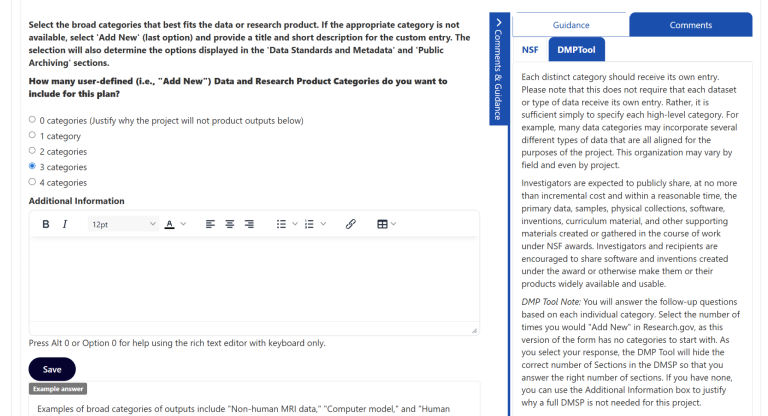
- Data or Research Product Category: Select the broad category that best describes your data/research product, or create a custom one with a title and description (up to 4 categories total)
- Access Policies and Limitations: Select up to 6 reasons (legal, privacy, security, etc.) explaining why data won't be fully publicly shared, plus a written explanation/justification
- Data Standards and Metadata: Select or define the data/metadata standard that will be used for this category of data
- Data or Research Product Provenance: Indicate whether the data comes from an existing resource, an existing dataset, or will be newly collected, and identify it if pre-existing
- Public Archiving: Specify where (typically an online repository) the data will be made publicly available
- Timeline for Public Accessibility: Select when the data will be shared publicly, ranging from time of collection to end of award, or mark as not applicable
- Data Availability: Specify how long the data will remain available and whether you will follow the chosen repository's standard retention policy
- Accountability: Designate one PI or co-PI responsible for ensuring the data is managed and shared as described
DMP Tool
To draft the plan itself, we recommend the DMP Tool (log in with HarvardKey) using the appropriate NSF template. Additional guidance for completing each section is available in DMP Tool. Find more information on DMP Tool.
Maintain Your Plan
Hopefully, your NSF grant application will be accepted, and you’ll be on your way to starting your research project! As you begin your work, you’ll want to periodically revisit your plan to ensure that it still fits your needs. Maintaining your DMS Plan will help you adhere to your commitments to the NSF and showcase your ability to manage your data in future grants.
Where Can I Get Help?
NSF Resources
- Dissemination and Sharing of Research Results
- Requirements by Directorate, Office, Division, Program or other NSF Unit
- Award & Administration Guide (AAG) Chapter VI.D.4
- Grant Proposal Guide (GPG) Chapter II.C.2.j
- Frequently Asked Questions (FAQs) for Public Access
Harvard Resources
- Webinar Recording: Learn about writing Data Management Plans
- Upcoming Workshops: Check the Countway Library Calendar for current offerings
Countway Library Guidance
Have questions or need help complying with data management and sharing practices? Contact us.
While a structured format reduces applicant burden, it may also reduce the intentional planning process that narrative plans encouraged. We still recommend drafting a robust DMS Plan for any research project to support effective data management practices throughout the entire project lifecycle, and setting the research team up for success for streamlined data sharing and compliance.