
Starting May 25, 2026 the NIH now requires researchers to submit a data management and sharing plan that follows a standardized questionnaire. Please see updated guidance below.
National Institutes of Health Requirement
NIH issued the Data Management and Sharing (DMS) Policy in 2023 to promote the sharing of scientific data. The policy requires all grant applications or renewals that generate scientific data to include a Data Management and Sharing Plan (DMS Plan) for how the data will be managed and shared during the entire funded period.
As of May 25, 2026 the new DMS Plan format is now a standardized questionnaire and data table.
What Is Required?
Under the DMS Policy, NIH expects that investigators and institutions:
- Plan and budget for the managing and sharing of scientific data
- Submit a DMS Plan for review when applying for funding
- Comply with the approved DMS Plan
The DMS Plan acknowledges commitment for data sharing, indicates where individual data types will be shared, and details any exemptions. The term scientific data is defined in the policy as "The recorded factual material commonly accepted in the scientific community as of sufficient quality to validate and replicate research findings, regardless of whether the data are used to support scholarly publications."
The DMS Plan will be assessed by NIH Program Officers (peer reviewers will comment on the proposed data management budget). The Institute, Center, or Office (ICO)-approved plan becomes a Term and Condition of the Notice of Award.
What Do I Need To Submit?
If you plan to generate scientific data, you must submit a Data Management and Sharing Plan to the funding NIH ICO as a separate attachment with your application. You should also plan to include a budget for data management and sharing in the Budget Justification section. Prepare your DMS Plan using the required 2026 Pilot DMS Plan Format Page (.docx).

Write An NIH DMS Plan
Researchers are expected to maximize the appropriate sharing of scientific data, taking into account factors such as legal, ethical, or technical issues that may limit the extent of data sharing and preservation. If your application is subject to NIH’s Genomic Data Sharing (GDS) Policy, you must also address GDS-specific considerations within the DMS Plan. Review the NIH guide for Preparing a Data Management and Sharing Plan. The Plan includes the following elements:
- Compliance: Will there be maximum appropriate sharing of scientific data underlying peer-reviewed publications and other findings resulting from the work supported by this award (including preprints, refereed papers reported at conferences, and other findings)?
- Compliance: Will the scientific data underlying peer-reviewed publications be shared by the time of publication or, for other findings, by the end of the period of performance, which includes no-cost extensions?
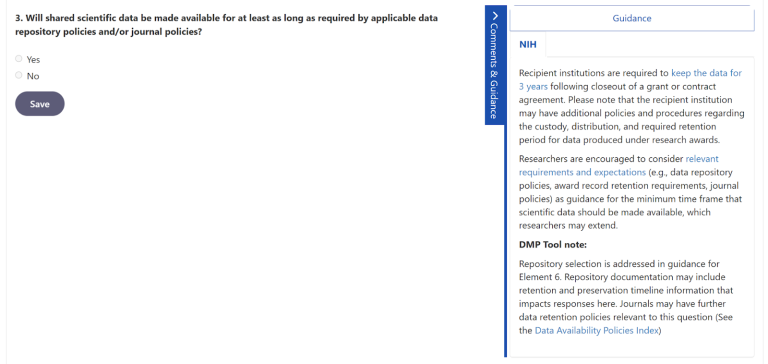
- Compliance: Will shared scientific data be made available for at least as long as required by applicable data repository policies and/or journal policies?
- Exemptions: If you answered “no” to elements 1, 2, or 3, or if you anticipate that sharing will be limited in some other way, please describe these limitations and the ethical, legal, or technical factors for them. Your response should specify a particular reason(s) for limiting sharing.
- Examples of what may or may not be justifiable factors for limiting sharing at Maximum Appropriate Sharing of Scientific Data.
- Protecting Human Privacy: If scientific data derived from human research participants will be shared, will privacy, rights, and confidentiality of participants be protected as outlined in NOT-OD-22-213, including whether any scientific data will be shared using access controls?
- Data Inventory: In table format, please list expected data types and repositories:
- Key types of scientific data anticipated to be generated during the project, including the species and modality, if known (e.g., “human genomic data,” “rat functional magnetic resonance imaging data”).
- The repository or an example of a repository where the scientific data may be managed and shared, if the scientific data is known at time of application. NIH expects the use of established repositories for preserving and sharing scientific data when they are available.
- Genomic Data Sharing Policy: For studies subject to the NIH Genomic Data Sharing Policy (GDS):
- Will you share all large-scale human genomic and associated data in a NIH-designated repository according to the accelerated timelines expected in the GDS Policy?
- Consult Where to Submit Genomic Data for repositories acceptable under the Genomic Data Sharing Policy.
- Consult NIH’s Data Submission and Release Expectations.
- Do you anticipate that when sharing large-scale human genomic data that you will be able to meet the expectations of the Institutional Certification in the GDS Policy?
- Consult Completing an Institutional Certification Form for different versions of certification forms for use based on source of NIH Funding, when samples were collected, and consent status for samples collected.
- Consult Completing an Institutional Certification Form for different versions of certification forms for use based on source of NIH Funding, when samples were collected, and consent status for samples collected.
- Will you share all large-scale human genomic and associated data in a NIH-designated repository according to the accelerated timelines expected in the GDS Policy?
DMP Tool
To draft the plan itself, we recommend the DMP Tool (log in with HarvardKey) using the NIH template. Additional guidance for completing each section is available in DMP Tool. Find more information on DMP Tool.
Maintain Your Plan
Hopefully, your NIH grant application will be accepted, and you’ll be on your way to starting your research project! As you begin your work, you’ll want to periodically revisit your plan to ensure that it still fits your needs. Maintaining your DMS Plan will help you adhere to your commitments to the NIH and showcase your ability to manage your data in future grants. Your plan may need to be updated or revised over the course of a project, and this can be addressed at during the annual RPPR process.
Where Can I Get Help?
NIH Resources
- NIH Scientific Data Sharing: Policies and Access to Data
- NIH Data Management and Sharing Policy
- NIH Writing a Data Management and Sharing Plan
- FAQs for the NIH Policy for Data Management and Sharing Policy
Harvard Resources
- Webinar Recording: Learn about writing Data Management Plans
- Upcoming Workshops: Check the Countway Library Calendar for current offerings
- NIH Data Management & Sharing Policy Briefing Sheet for Harvard Researchers (PDF): Policy Overview and Implications
- Harvard NIH DMSP Budgeting and Application Instructions (PDF): Tip Sheet for Principal Investigators and grant managers
- Countway Library's NIH Data Management and Sharing Policy FAQ: Harvard-focused answers based on current NIH guidance
- Affiliate Resource and Contact Directory: Local resources and contacts for the NIH DMSP
More Resources
- Review the critical aspects of the policy in the Science article "Ready, set, share: Researchers brace for new data-sharing rules"
- Read recent articles from the Harvard Data Science Review on "Changing the Culture on Data Management and Data Sharing in Biomedicine"
- Visualize key recommendations in the PLOS Computational Biology article "Ten simple rules for maximizing the recommendations of the NIH data management and sharing plan"
- Utilize the FASEB DataWorks! Data Management Plan (DMP) Challenge Evaluation Rubric
Countway Library Guidance
Have questions or need help complying with data management and sharing practices? Contact us.
While a structured format reduces applicant burden, it may also reduce the intentional planning process that narrative plans encouraged. We still recommend drafting a robust DMS Plan for any research project to support effective data management practices throughout the entire project lifecycle, and setting the research team up for success for streamlined data sharing and compliance.